
Confirmed for this version
Know the constraints before you commit
 Official game image
Operational sequence
What to do in a live run
- 01Step 1
Choose the learning environment first
Use Tutorial or Solo for unfamiliar controls and routes; use Beginner when the team needs live co-op practice with more recovery room. Difficulty is not a badge—it changes the match’s failure cost.
Official notes + field adviceS1 - 02Step 2
- 03Step 3
Budget the reward against the completion chance
Hard and Nightmare multipliers only matter after a successful run. If the team cannot reliably secure Supplies and extraction, the higher headline rate may produce less usable progression.
Field advice - 04Step 4
Recheck ammunition rules before Nightmare
Nightmare’s scarcity leans more on unloading weapons you find, and its threat composition is heavier. Treat found weapons and reserve ammunition as a shared plan, not personal loot.
Official notesS1
Brief 01
Beginner and Normal
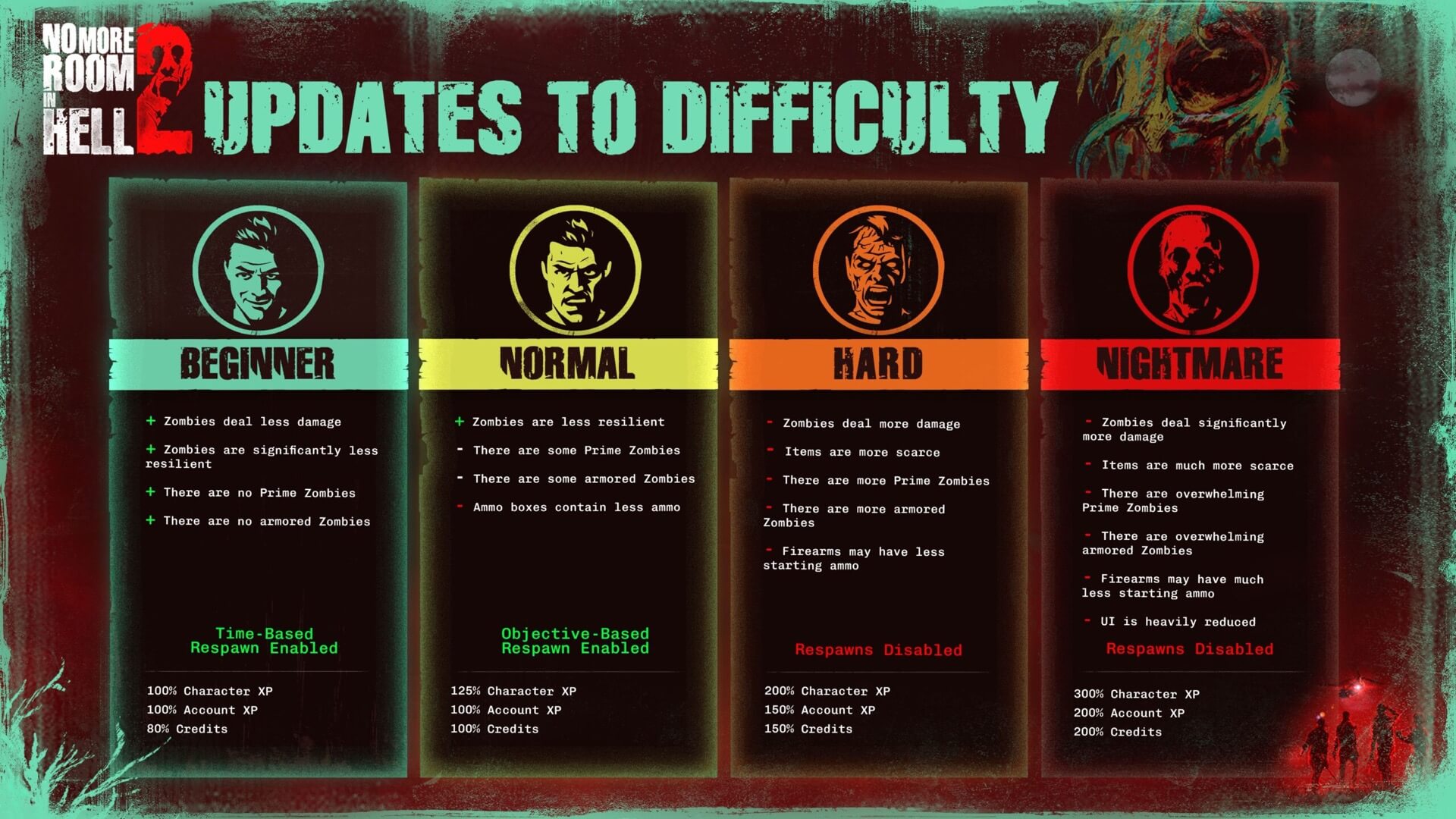
Beginner reduces effective zombie health by 30%, adds control hints and uses timed one-minute respawns. Normal enables respawning after a major objective and grants 125% character XP. Resupply 1.1 added a final respawn window at the start of the extraction sequence on Normal, completing the respawn coverage that 1.0.4 brought only to Survival. On both difficulties, a pre-respawn team wipe or death after extraction is called can still permanently lose the Responder.
Brief 02
Hard rewards
Hard enables permadeath from spawn and grants 150% account XP, 200% character XP and 150% Credits. The higher multiplier only matters if the run survives long enough to convert its Supplies.
Brief 03
Nightmare rewards
Nightmare grants 200% account XP, 300% character XP and 200% Credits, with more Runners, Primes and special infected plus greater ammo scarcity. Treat it as a high-stakes progression option, not a learning mode.
Before commitment
Run checklist
- Confirm when permadeath becomes active.
- Match the difficulty to the team, not one player.
- Budget scarce Nightmare ammunition before contact.
- Equip a Rescue Beacon only when the protected loss justifies it.
Decision support
Situation → action
| Situation | Action | Why |
|---|---|---|
| Learning maps or systems | Training, Solo or Beginner | More recovery opportunities and lower combat pressure. |
| Developed Responder, stable team | Consider Hard | Higher progression without Nightmare’s full pressure mix. |
| Prepared squad seeking maximum return | Nightmare | Highest multipliers with immediate permadeath and scarce ammo. |
FAQ / practical answers
Questions players ask before the next run
Which difficulty should a new squad choose?
Start with Tutorial or Solo for basic learning, then Beginner co-op for a more forgiving team environment. Move up only when the squad can communicate routes and recovery decisions reliably.
Does difficulty change weapon damage?
Official 1.0 melee notes say weapon damage no longer changes across difficulty settings. Difficulty changes pressure, composition, recovery and reward rules instead.
How do respawns differ on Beginner and Normal?
Beginner uses minute-based respawns; Normal enables respawns after a major objective. Neither rule removes every permadeath scenario.
Are Hard and Nightmare rewards guaranteed?
No. The multipliers apply to a successful result; they do not erase the higher risk of losing the run or the Responder.
What makes Nightmare different beyond rewards?
Official notes call out more Runners, Primes and special infected, plus greater ammo scarcity. It is a distinct pressure profile, not simply a larger number.
Updated for the version shown above. Open the sources panel for the related game notes.
Updates linked to this page
These updates may change the route, value or rule described on this page. Open a patch to see the affected area.